Hot Water Slab Leak Repair in Vista, CA
Hot water lines fail far more frequently than cold water pipes due to repeated thermal expansion and contraction against foundation aggregate. Stop skyrocketing gas bills and warm floor damage with specialized diagnostic repairs.
Why Hot Water Domestic Lines Fail First Under Foundation Slabs
In Vista residential properties, statistics show that nearly seventy percent of all sub-slab copper pipe failures occur on domestic hot water supply lines. While cold water lines maintain relatively stable ambient temperatures year-round, hot water pipes experience radical thermodynamic fluctuations. Every time a shower is run or a dishwasher cycles, water heated to 120 to 140 degrees Fahrenheit surges through copper lines encased in cold sub-slab soil.
This temperature surge causes the metal to expand lengthwise. As the pipe cools, it contracts back to its original dimensions. When tract builders in Vista poured concrete foundations during the 1970s, 1980s, and 1990s, copper lines were frequently laid directly against crushed rock gravel or sharp concrete aggregates without protective PVC wrapping. Over thousands of heating and cooling cycles, this continual movement acts like coarse sandpaper against the pipe's outer wall, leading to friction wear, thinning, and sudden rupture.
Telltale Symptoms of a Hot Water Line Leak Under Slab Vista Homes
Homeowners dealing with a ruptured hot line generally notice a combination of physical and utility symptoms that differ from cold-water leaks:
- Noticeable Warm Spot on Floor Vista: Walking barefoot across tile, vinyl, or carpet reveals an isolated, uncomfortably warm patch of flooring. In severe cases, pets will curl up directly over the warm spot.
- Water Heater Running Constantly Vista: Because hot water is continually discharging into the soil under pressure, your water heater burner or electric element never shuts off, struggling fruitlessly to satisfy the tank's thermostat.
- Massive Gas or Electric Utility Surges: A sudden spike on your monthly SDG&E statement, often doubling or tripling normal energy charges, is a hallmark sign of a thermal hot-line breach.
- Diminished Hot Water Volume and Pressure: Showers lose hot water in minutes because a significant portion of heated volume is continuously bleeding out into the foundation gravel bed.
- Swelling Baseboards and Buckled Flooring: Prolonged exposure to hot moisture causes hardwood planks to cup, adhesive beneath luxury vinyl to liquefy, and baseboard millwork to warp away from wall framing.
Emergency Mitigation: Shut Off Your Water Heater Inlet Valve
If you feel an active warm spot on your floor, locate the cold water shutoff valve positioned directly above your water heater tank (or tankless unit) and rotate it to the closed position. This immediately halts the flow of pressurized water into the leaking hot water circuit while preserving cold water service to your toilets and sinks until our technician arrives.
Diagnostic Isolation: Thermal Imaging and Pressure Profiling
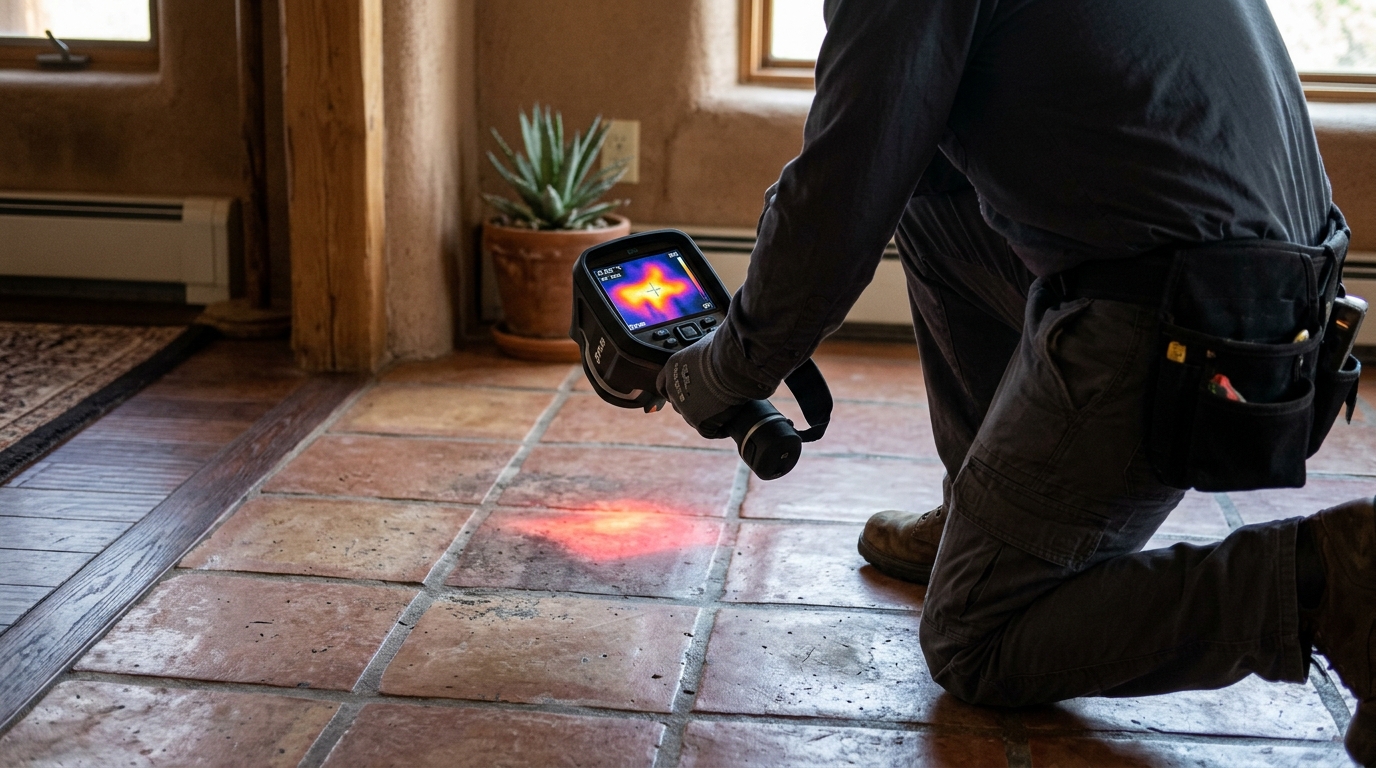
Diagnosing a hot water line leak under slab Vista structures requires specialized infrared technology. Because hot water naturally conducts heat upward through dense concrete, our FLIR high-resolution thermal imaging cameras detect surface temperature variances as subtle as 0.1 degree Celsius.
When viewed through thermal imaging, a hot-water slab leak appears as a distinct thermal blooming pattern. The hottest focal point corresponds to the precise underground rupture, while diffuse color gradients reveal the direction of water migration. Combined with digital pressure gauges attached to your hot-water distribution manifold, we verify the leak's severity without unnecessary demolition. For comprehensive diagnostic techniques, visit our slab leak detection page.
Hot Side Solutions: Repair vs. Overhead Reroute
Once the leak is pinpointed, homeowners face an important engineering decision: should you perform a direct spot repair through the concrete, or permanently reroute the failing line overhead?
Spot Repair Assessment
A direct repair involves jackhammering through the slab over the leak point, cutting out the failed copper segment, and brazing in a new piece. However, because thermal stress affects the entire hot line, fixing a single spot in a fatigued 30-year-old copper pipe often results in a secondary leak a few feet away within months.
Single-Line Hot Reroute
The industry gold standard for hot-side failures. We abandon the entire buried hot water run beneath the slab, capping both ends permanently. A continuous, insulated PEX-a line is run from the water heater through the attic or ceiling joists to the affected fixture group, permanently resolving the risk. Explore details on our slab leak reroute page.
Water Heater Integration
When hot slab leaks cause water heaters to fire continuously for weeks, internal tank liners and heating elements frequently suffer severe scale build-up and premature failure. We evaluate the water heater's operating condition to ensure your system operates safely after pipe repair.
Local Vista Plumbing Considerations
Properties throughout Vista, from Shadowridge to Downtown Vista, frequently feature plumbing configurations where hot water lines were installed with minimal pipe clearance. In homes where multiple pinholes emerge over time, a single line reroute may be followed by broader upgrades. Homeowners dealing with extensive system corrosion often transition to our whole-house repiping service or explore targeted pinhole leak repair strategies.
To schedule an on-site evaluation or speak with a local foundation plumbing specialist regarding your hot water line, call our team directly or consult our overview of slab leak repair in Vista.